


Blog
Refresher Course - Neuromotricity and Musical Interpretation in the Teaching of String Instruments with Cristina Bellu

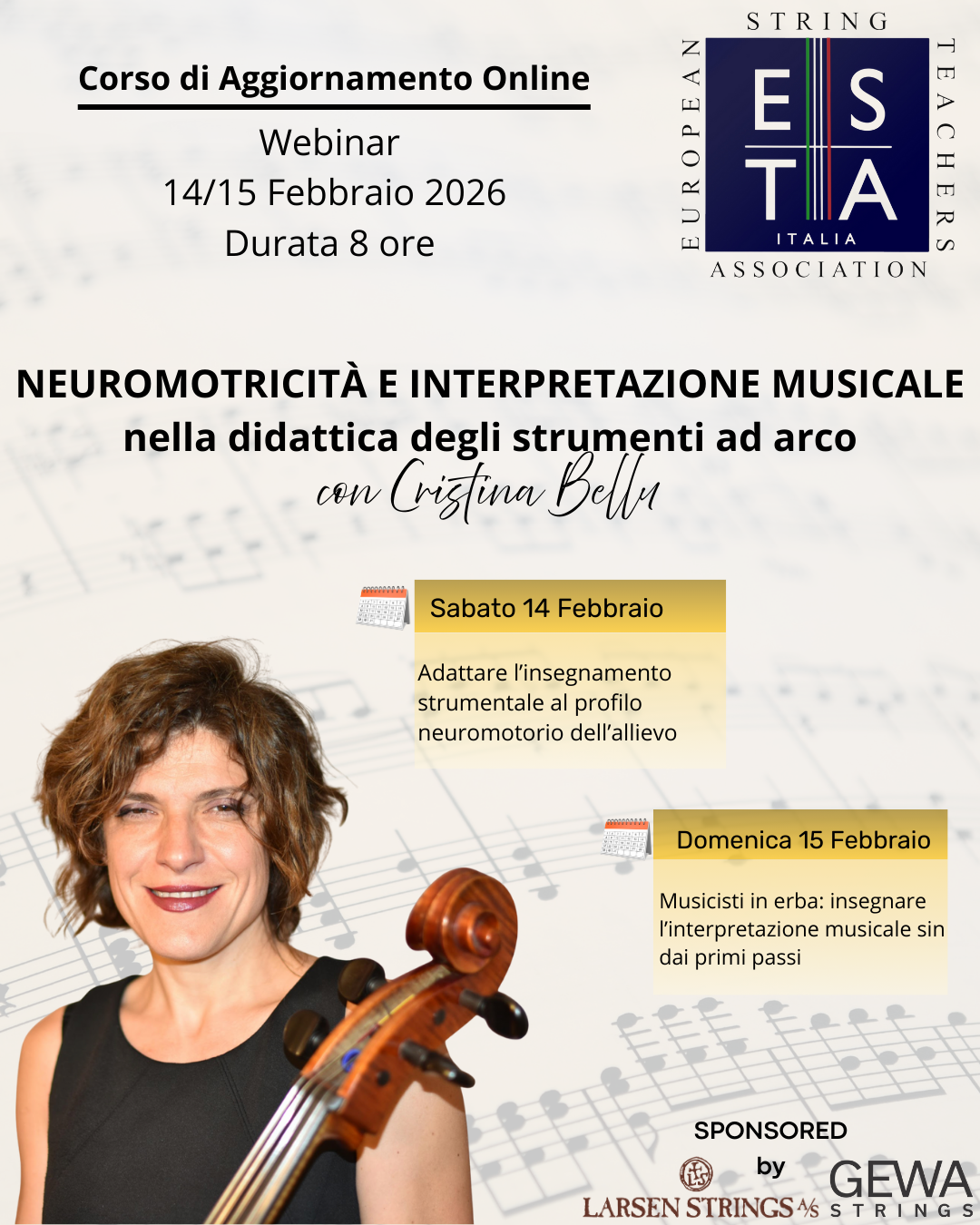
ESTA Italy is pleased to present a recognised update webinar course, held by Cristina Bellu, cellist, pedagogue and researcher active between Switzerland, France and Italy. The course will take place online at Zoom on days Saturday 14 and Sunday 15 February 2026, for a total duration of 8 hours.
The training course is divided into two complementary meetings, dedicated to two central aspects of contemporary instrumental teaching: adaptation of teaching to the learner's neuromotor profile is education in musical interpretation from the very first steps on the instrument.
Saturday 14 February 2026 (4 hours)
Adapting instrumental teaching to the learner's neuromotor profile
The adaptability of teaching to the cognitive, motor and emotional capacities of the pupil is today a shared necessity. In particular, the ability to select appropriate instrumental movements, reproducible within a reasonable time and respectful of spontaneous motor skills, is a fundamental key to effective learning.
This meeting offers a theoretical and practical approach to the neuromotricity applied to string instruments, through collective exchange, small group work, observation of lectures and presentation of scientific research.
Course objectives include:
-
reflect on the teaching repertoire and tools available to the teacher
-
acquire notions of motor skills applied to the study of the instrument
-
understand the concept of motor profile and its importance in learning
-
identify empirical indicators of the learner's motor profile
-
develop strategies to adapt teaching to different motor profiles
Participants will be invited to share teaching materials, experiences, difficulties and complex cases, including through short videos.
Sunday 15 February 2026 (4 hours)
Budding musicians: teaching musical interpretation from the very beginning
What is musical interpretation? Is it possible to teach it? And above all: how to help students become musicians and not just “technicians” of the instrument?
This second meeting addresses the theme of’musical interpretation in education, clarifying the concepts of interpretation, expressiveness and musicality and proposing theoretical models and concrete strategies for working with children and young people.
The course aims to:
-
provide theoretical foundations on musical interpretation studies
-
present useful models for teaching practice
-
offer strategies and exercises for teaching interpretation on string instruments
-
propose progressive training paths dedicated to musical expressiveness
Also in this meeting, the sharing of participants' experiences will be an integral part of the work, with a focus on difficulties, individual differences of learners and possible causes.
The rapporteur
 Cristina Bellu is a cellist and dedicates her professional activities to concerts, teaching, training, post-training and research. After obtaining her diploma in cello at the Conservatorio Luigi Cherubini in Florence, she specialised at Roosevelt University in Chicago where she obtained her Master of Music. She then went on to further her studies in France, under the guidance of Jean Deplace, and obtained a Doctorate in Education at the University of Geneva. Her repertoire ranges from baroque music on period cello to contemporary music, including tango and pop music. Compositions by Hardy Mertens and Garth Lawrence are dedicated to her. She teaches at the Conservatoire à Rayonnement Départemental in Mulhouse (F) and at the Birémis and Atempy schools, where she also takes care of disabled pupils. At the Haute École de Musique Vaud-Valais-Fribourg, he teaches cello didactics and supervises numerous students in the written work of Masters in Pedagogy, conducts interdisciplinary workshops and chairs juries. His research focuses on instrumental didactics in the areas of movement, interpretation and applied didactics.

